Study of seed viability in herbarium specimens
Herbarium specimens for the recovery of lost genetic variability
Description
The more than 400 million herbarium specimens in existence worldwide represent a seed source for the recovery of lost genetic diversity (de-extinction).
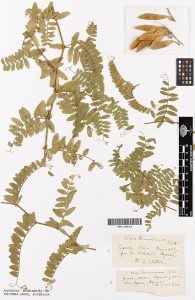
Vicia dennesiana
The recovery of rare or extinct plants from historical herbarium specimens is often hampered by the need to perform destructive germination tests on precious and limited seeds. Furthermore, our studies indicate that only 1% of seeds from herbarium specimens were viable. Using X-ray microtomography (micro-CT), a non-destructive 3D imaging technique, we analyzed the internal and external structure of seeds to predict germination ability without damaging them. The extremely rare Hieracium australe subsp. australe was used as a model.
The analysis revealed that germination failure is associated with smaller seeds, thicker outer protective tissues, and high embryo porosity. However, exposure to X-rays dramatically reduced germination of treated seeds.
In an ongoing study on species of the genus Vicia (Fabaceae), we are testing the effectiveness of seed priming techniques to increase germination by stimulating natural antioxidant and DNA repair mechanisms during seed reactivation.
The aim of this latest work is to identify an effective priming protocol for recent Vicia seeds and apply it to seeds of Vicia dennesiana, a now extinct species endemic to the Azores.